I’ll get this right out there: I’m not very concerned about the Birkie conditions this year. But the weather the week before will be, to use a Upper Midwesternism, interesting.
First thing, the Birkie has, as usual, closed the trail starting at 11:59 p.m. on Sunday night. They want to have the trail cleared for grooming, but they also don’t want anyone putting ruts in a soft trail. And that could be the least of their problems.
I’ll go into some detail below, and stay tuned to The Podcast this weekend for a catch up with Ketzel Levens, who will do some model interpretation for us as well.
Here’s where we are. For the past couple of months, most of the weather in the Northwoods has been from northern-stream clipper systems, with cold dry air punctuated by light snowfalls. During that same time, out west, there has been scant snowfall. California had some heavy snow around the new year, otherwise, it’s been dry. Alta, for instance, has had its lowest snowfall in more than 20 years. It’s probably good the Olympics aren’t in Salt Lake this year.
But that’s about to change. A series of storms is about to blow into the Sierra, across the Rockies, and then tap into Gulf moisture and stream north and affect the Upper Midwest. The first of these is poised to slam into California on Monday and then reform as a Colorado Low across the Plains by Tuesday, and what falls on the Birkie will be affected by how and where that low forms. Before then, it’s going to be warm, but not too warm, for the next few days, with highs in the low 40s, and lows in the low 20s. Much warmer, and we’d be in deep trouble snowpack-wise, but I think that given the dry weather, light winds and overnight cooling, the snowpack should mostly stay intact, although the Birkie may have to worry about a few south-facing hills with the mid-February sun.
Then the storm ejects across the Midwest. A quick reminder on how weather models work. Weather models divide the atmosphere into a three-dimensional grid, and then take the data of the conditions in that grid and … run with it. This gives a deterministic outcome, based on the initial conditions, it shows a specific outcome (often called the “operational” outcome). Oh and there are AI “models” too, we’ll ignore them for now (they’re not bad, just another tool in the shed). As with any model, this is prone to cascading error based on initialization errors, and since a lot of the data collected is collected by satellite or other measures over the Pacific at this range, we know that there are initialization errors. So weather models then perturb the initial data and run an “ensemble suite” of these perturbations to get an idea of potential outcomes. That’s more useful at this range.
For the Wednesday storm, the models show low pressure tracking anywhere from the Minnesota-Iowa border (or even a bit further south) to Duluth. (Below is the GEFS model from WeatherNerds.com.)
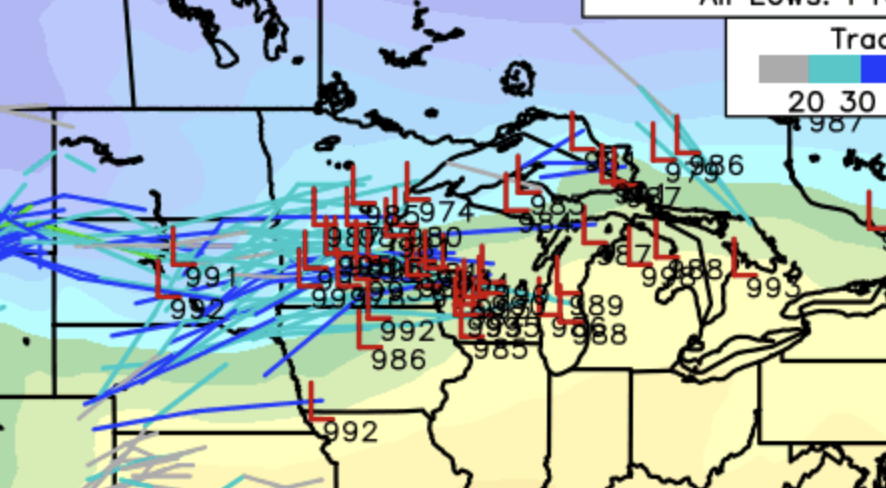
For actual weather, this track matters a lot. A track near Iowa means a snowstorm for the Birkie. A track over Duluth a rainstorm. And somewhere in between, well, somewhere in between. Our friends at the National Weather Service’s Duluth office are predicting “a change of rain or snow” because they’re looking at the same model data that I am.
If we look at some recent deterministic model runs, we see a similar spread. The 18Z GFS model has rain on Wednesday changing to snow accumulating several inches. This would make for a very messy, miserable Open Track on a wet, soft course with rain and wet snow falling, to the point where, if I were the Birkie, I’d consider pushing the Open Track to Thursday. The GFS has 5″ of snow in Hayward, but potentially significantly more in Cable, and more than a foot in Duluth. The Canadian model is a few miles south, with a foot in Hayward, but a sharp cutoff with almost nothing one county south (Rusk). Meanwhile, the European model, which was a northern outlier yesterday, has now pushed south and is showing a more southerly track and snow band, with Hayward on the northern edge of the heaviest snow.
Once this first storm passes, the pattern stays active, but the jet stream pushes south a bit, so it allows colder air to flow in. So as long as there is not a large correction north, which would allow warm rain to fall, there should be cold weather by Thursday morning to freeze up the trail, no matter how much snow falls on top. The Birkie will probably then focus on grooming the southern end for Friday events, and then the whole trail for Saturday, by which time some models suggest there may be more snow.
So if you thought you were going to dial in your wax job this weekend, well, good luck with all that! You can use the code podcast over at PioneerMidwest.com for their race wax service (thanks, Matt, who is right now at the Olympics watching Jessie, but is coming home for The Race). And stay tuned for Ketzel talking weather and probably some classic wax this weekend!