Weather speculation: rain/snow line.

I’ll get this right out there: I’m not very concerned about the Birkie conditions this year. But the weather the week before will be, to use a Upper Midwesternism, interesting.

First thing, the Birkie has, as usual, closed the trail starting at 11:59 p.m. on Sunday night. They want to have the trail cleared for grooming, but they also don’t want anyone putting ruts in a soft trail. And that could be the least of their problems.

I’ll go into some detail below, and stay tuned to The Podcast this weekend for a catch up with Ketzel Levens, who will do some model interpretation for us as well.

Here’s where we are. For the past couple of months, most of the weather in the Northwoods has been from northern-stream clipper systems, with cold dry air punctuated by light snowfalls. During that same time, out west, there has been scant snowfall. California had some heavy snow around the new year, otherwise, it’s been dry. Alta, for instance, has had its lowest snowfall in more than 20 years. It’s probably good the Olympics aren’t in Salt Lake this year.

But that’s about to change. A series of storms is about to blow into the Sierra, across the Rockies, and then tap into Gulf moisture and stream north and affect the Upper Midwest. The first of these is poised to slam into California on Monday and then reform as a Colorado Low across the Plains by Tuesday, and what falls on the Birkie will be affected by how and where that low forms. Before then, it’s going to be warm, but not too warm, for the next few days, with highs in the low 40s, and lows in the low 20s. Much warmer, and we’d be in deep trouble snowpack-wise, but I think that given the dry weather, light winds and overnight cooling, the snowpack should mostly stay intact, although the Birkie may have to worry about a few south-facing hills with the mid-February sun.

Then the storm ejects across the Midwest. A quick reminder on how weather models work. Weather models divide the atmosphere into a three-dimensional grid, and then take the data of the conditions in that grid and … run with it. This gives a deterministic outcome, based on the initial conditions, it shows a specific outcome (often called the “operational” outcome). Oh and there are AI “models” too, we’ll ignore them for now (they’re not bad, just another tool in the shed). As with any model, this is prone to cascading error based on initialization errors, and since a lot of the data collected is collected by satellite or other measures over the Pacific at this range, we know that there are initialization errors. So weather models then perturb the initial data and run an “ensemble suite” of these perturbations to get an idea of potential outcomes. That’s more useful at this range.

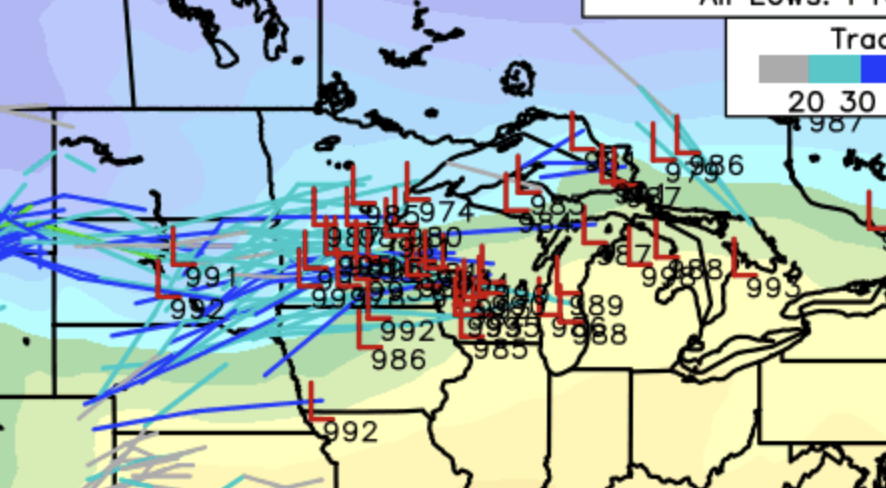
For the Wednesday storm, the models show low pressure tracking anywhere from the Minnesota-Iowa border (or even a bit further south) to Duluth. (Below is the GEFS model from WeatherNerds.com.)
Screenshot 2026-02-12 at 21.18.12

For actual weather, this track matters a lot. A track near Iowa means a snowstorm for the Birkie. A track over Duluth a rainstorm. And somewhere in between, well, somewhere in between. Our friends at the National Weather Service’s Duluth office are predicting “a change of rain or snow” because they’re looking at the same model data that I am.

If we look at some recent deterministic model runs, we see a similar spread. The 18Z GFS model has rain on Wednesday changing to snow accumulating several inches. This would make for a very messy, miserable Open Track on a wet, soft course with rain and wet snow falling, to the point where, if I were the Birkie, I’d consider pushing the Open Track to Thursday. The GFS has 5″ of snow in Hayward, but potentially significantly more in Cable, and more than a foot in Duluth. The Canadian model is a few miles south, with a foot in Hayward, but a sharp cutoff with almost nothing one county south (Rusk). Meanwhile, the European model, which was a northern outlier yesterday, has now pushed south and is showing a more southerly track and snow band, with Hayward on the northern edge of the heaviest snow.

Once this first storm passes, the pattern stays active, but the jet stream pushes south a bit, so it allows colder air to flow in. So as long as there is not a large correction north, which would allow warm rain to fall, there should be cold weather by Thursday morning to freeze up the trail, no matter how much snow falls on top. The Birkie will probably then focus on grooming the southern end for Friday events, and then the whole trail for Saturday, by which time some models suggest there may be more snow.

So if you thought you were going to dial in your wax job this weekend, well, good luck with all that! You can use the code podcast over at PioneerMidwest.com for their race wax service (thanks, Matt, who is right now at the Olympics watching Jessie, but is coming home for The Race). And stay tuned for Ketzel talking weather and probably some classic wax this weekend!
Weather speculation: should we be concerned?

So far this year, the weather in Hayward has been pretty much perfect. December began with a deep freeze to freeze the lakes solid. January was cold and added some snow to the trail. (There was a high of 38 above and a low of 38 below.) There is a compacted base of 8 to 12″ of snow on the trail (and more ice than that on the lake). February has started off a bit warmer, but not anything that would impact the snow.

So far.

But the next week looks dicey. All of the models have some above-freezing temperatures. 40 is fine as long as it gets cold overnight and refreezes (in fact, for the race, it’s probably preferable). What we don’t want is a replay of 2000. That year was looking fine until the week before the race, when a sudden warmup with six straight days in the 40s, and four cracking 50s, canceled the race, and making national news. Apparently there was enough snow some of the race could have occurred, but there was standing water on the trail in several points, the day before the race was warm (in the 40s or higher all day), wet and windy.

So far this year doesn’t look nearly that bad. The next week will be warm. The NWS has four days in the 40s starting on Friday, but these look to be dry and temperatures should fall well below freezing each night. Dry air does not melt snow as quickly as moist air, and overnight temperatures refreeze the snow meaning it takes more energy to warm up before any melts the next day. The day to watch is next Tuesday and Wednesday. A weather system will move across the Northwoods on Tuesday and Wednesday, and its track and strength will determine how much of an issue it is for the race (sorry, Open Track skiers, it might not be a great year for the Open Track event).

If it evolves as the American model suggests, a low pressure center tracks across Iowa and would cool down enough to put some fresh snow on the course, and then draw in cold air afterwards for a good race. The Canadian tracks this feature as a disorganized system across Northwest Wisconsin, and would create some air and warmer temperatures, but would cool it down enough to freeze up for the race (and probably would impact the snow, but not too severely). The European model stalls the low even further northwest, then pivots warm-sector moisture around it to the southeast, still dropping some rain for Birkieland but, again, probably in a time frame where it would refreeze before the race. (It also shows a Birkie blizzard, with several inches of snow falling during the race.)

This warmer forecast is certainly suboptimal, and the groomers may well have their work cut out for them. But as it stands right now, we’re not facing a week of temperatures in the 50s and heavy rain like 2000 or 2017 (or 1981, 1998 or 2002). No model touches 50, let alone shows several days. But that said, we should remain a bit on edge in case it trends to the outside of the envelope of possibility.

Support Decade #2 of the Cowbell Fever podcast

Sometimes I have trouble remembering exactly how long I’ve been hosting a podcast. I have a good idea about the Birkie Guide itself (the original was a blog post in 2010) but luckily the podcast feed file has the date of the first one and it was January 27, 2016. That’s more than 10 years ago! That first year we had a podcast episode with Ben Popp, another at a pasta feed the night before the race, and then the inaugural Main Street episode (a scant 25 minutes long). A decade later, I’m still chasing interesting stories about the race, and still cracking beers on Main Street after the race with my friends and, after a bit more New Glarus, anyone I can shove a mic in front of. It’s a blast, and I still want to thank everyone who reads and listens, especially when I get to meet you in Hayward (or at the start of an ultra on the North Shore, or a train from Philly to New York, or on a bus after a Worldloppet race in Austria).

This has been and will be a labor of love, that’s for damn sure, but there are costs involved (web hosting, some modicum of equipment, my copious spare time) and if you want to help defray these, the site does have a Patreon. The deal is, you put in a dollar each month (or more) and covers a bit of the outlay for this site and podcast. And if we get to 10 subscribers (we’re at 7, so most of the way there) then I order a bunch of Cowbell Fever cowbells, because who doesn’t love a novelty cowbell? The site here remains free, and our sponsors get a good deal (Pioneer Midwest waxes my skis and with code “podcast” you get skis waxed, too). I mean, if you want to cut a check, then yeah, we can figure out sponsorship as well (I actually did do a survey a user survey a couple years ago).

I know that times can be tight and the Birkie isn’t getting any cheaper (that said, you get what you pay for, and that’s a good thing). Neither are skis, or wax, or boots (I just needed a new pair of classic boots and thank goodness the shop had an older pair, because it would have been hard to part with $700 for this year’s model, even if it is a boa and Jessie Diggins is wearing it). You can be sure we’re not about to set up a paywall, or have exclusive bonus episodes, we’re not that fancy. But if you’re lucky enough that you are in a position to be a Patreon, well, I’m honored that you appreciate my now decade-long project. As always, you can give a rating or drop a review or shoot me an email or find me on Main Street (look for the guy in the media bib). I appreciate that just as much. Especially if you find me on Main Street and hand me a brat (with mustard and extra kraut).

I have a list of podcasts I would like to record, and it’s not short! A few I’m already starting pre-production (lining up guests, etc). It’s been a busy past year (I have a 15-month-old and have accompanied him and my wife on a bunch of her work travel) so I’ve fallen behind, but am going to try to commit to more podcasts this year.

So thank you for reading, listening and, if able, supporting the next decade of the Cowbell Fever Podcast!

Birkie 2026 is almost here!

And … no news is good news.

2025 we weren’t really sure at this point if we were going to have enough snow at this point and didn’t find out until mid-month.

2024 was, well, we know what 2024 was.

2023 had lots of snow, but was warm enough we weren’t sure the lake would be frozen enough.

This year? Enough snow, tons of ice, and some warm weather upcoming but nothing too hot. Good trail, good grooming, not much to worry about. We have a podcast with Ben Popp (a Poppcast?) talking about the race, and it sounds not too bad!

We’ll make some changes here as needed but for the most part, we’ll see you soon in Wisconsin!

Trail closes at midnight Monday morning

If you want to get your fix of the Birkie Trail before race day, right now is your last chance. The trail closes at midnight and is closed Monday and Tuesday before the Open Track event on Wednesday.

If you go elsewhere, I wouldn’t expect busy trails with this weather:

Mostly sunny and cold, with a high near 0. Wind chill values between -25 and -35.

We should all be thanking our deity of choice that the Birkie is Saturday (Partly sunny, with a high near 22) and not tomorrow.

If you’re skiing the Open Track, bundle up. Temperatures will barely crack zero (although winds should be calmer). Thursday and Friday will be up towards 20.

All systems go

At the first Birkie webinar, they said they really needed about a foot of snow to have a good race. 10 days later, the results are in and Hayward has received 13″. It hasn’t been the thick base-building snow they would have liked, but it’s a foot of snow and it’s been cold, and with 5″ coming yesterday and a bit more during the day today, the Birkie should be in business for a perfect trail.

This is quite impressive given the situation two weeks ago, when the trail had lots of visible grass and dirt. Hayward had seen a total of 6.3″ of snow in all of January after a nearly snowless December (and one which had a warmup at the end which melted anything which would have been there. Here’s a photo from Skinnyski on Jan 26 from Jack Burns:

Here’s Mike Keyes on Jan 18:

It was a bit of a hopeful/gutsy call by the Birkie staff to put their faith in the weather forecast (and, to some extent, climatology) and go with the full course, but we will all be rewarded with a course which, I expect, will bear no resemblance to what it looked like a few weeks before.

So when will the warm-up occur? (#weatherspeculation)

I’m not concerned about a warm-up before race day. The snow that’s there, and whatever falls this weekend, will be there. 2017 this is not. Except for Friday and Saturday, when the temperatures will reach to nearly 20 (balmy!) Hayward shouldn’t break 10 until next Wednesday. Lows most nights will be in the -10 to -20 range, and often colder. We could race in that, but like Bartleby, I’d prefer not to.

Luckily, I don’t think we’ll have to. Take a look at the map below. It shows the temperature outlook for the week starting Thursday before Birkie. Since weather patterns often progress west to east in the US, this suggests that the pattern may start off colder and move towards warmer, and since average high temperatures in Hayward are nearly 30 in late February, we could be looking at near normal temperatures during this range. During a transition from colder temperatures to warmer temperatures, there’s often a departing high pressure system, which can mean cold but calm conditions to start with warm sunshine by afternoon, the perfect weather for the Birkie,.

8 to 14 Day Outlook - Temperature Probability

Reading the model tea leaves, they all suggest this in the longer range, but occurring at different times. The GFS suggests that Friday (Korte Day) would be around -20˚ to start, but “warm up” to nearly 20˚ by afternoon. Birkie day would fall back to 10˚ to 15˚, but make 30˚ by the Lake (this is my favorite Birkie weather). The European and Canadian models shows this happening a day later (with Korte Day barely making it to 10˚, and Birkie Day maybe making it to 20˚). If they’re right you’ll need more Aquavit to stay warm cheering on the lake!

We’re going to Hayward*!

(* probably, but isn’t that always the case?)

As you may have heard on the Birkie’s webcast, or as you may have heard on our podcast, the Birkie has gone out and sampled, prodded and tasted the snow and they’re confident they can get the race to Hayward. That’s why everything south of Gravel Pit is closed to skiing: to give them the best opportunity to keep the course in the best shape they can get it in given the conditions. You may see some twigs or grass, but you’ll mostly see snow, for 50 kilometers (55 if you’re striding), from Cable to Hayward, as it is meant to be.

A bunch of notes!

  • There’s obviously contingency plans, but with more snow on the north end, the revolve around a single, long loop and nothing like last year.
  • The snowmaking trails will remain open for training through race day (or close to it) and the rest of the trail north of Gravel Pit will be open the rest of this week. It will likely close at some point before or during race week.
  • There’s some snow in the forecast for this weekend. If it comes, it will help a lot, although it will be more cold and dry snow, and the Birkie could really use some moisture.
  • That said, the cold temperatures, down to -20˚ every day, should help the grooming team harden the course as they prepare it.
  • They’re focused on downhills, and a few in particular: the south-facing downhill after Gravel Pit, the long downhill after Bitch Hill, and the downhill to Duffy’s Field. The most worrisome hills are those which you can’t see the bottom, meaning people are more likely to snowplow (so … don’t snowplow). So there will be shovel crews heading out to try to throw more snow on those areas, email ben.popp@birkie.com if you want to sign up for a shovel crew starting … today!
  • You may not want to use your best skis for this race (but then again, since it counts for wave placement, you may!). If you have brand new skis [raises hand] you have a decision to make. I think I’ll probably use mine, but it may not be a wise choice. It certainly won’t be like the 2007 fast grass and graupel ski to OO, but might not be the thick carpet of snow we’re used to.
  • There may not be classic tracks set on the southern portion of the trail so, classic skiers, take that under advisement.
  • The lake, bridge and town should be in fine shape. It’s been cold and there’s no thick blanket of snow on the lake so there’s plenty of ice. No water skiing or ice skating this year.
  • Temperature-wise, the weather looks great. As much as the Birkie might love a sunny day around 35 to put some moisture in the snow, the current forecast doesn’t have temperatures above about 22 until race day. The snow that is there isn’t going anywhere. But there are no big storms on the horizon, so it’s sort of more of the same.

And in case you were wondering, I’d guess there’s now a 90% change we go to Hayward. And the other 10% is nearly all a 45 kilometer loop, but even that’s unlikely. Guys, we did it. It’s not 2024 anymore.

Snow report

Good Friday morning … here’s the latest on snow in Birkieland.

Wednesday evening’s snow fell quickly and steadily and blanketed basically the whole of the Birkie Trail with 2 to 3 inches of snow. The Birkie groomed the whole trail on Thursday although there are likely still thin spots and it is certainly not enough to allow the race to take place on the full trail, but it’s a start.

And that’s good, because something is coming this weekend. It will snow, the question is how much, and where the storm and gradient sets up. There will almost definitely be more snow as you go south, and the current forecast for Hayward sounds promising:

The latest snowfall forecast
favors the greatest potential for 3-6 inches of snow along and
south of US-2 in NW WI and south of MN 210 in Minnesota. The
highest of these amounts are generally favored along and south
of a line from Hinckley to Hayward to Park Falls where there is
a 20-40% chance of 6" or more snow accumulations.

There are ifs there, though. If the storm tracks south by 50 miles (as some modeling suggests) then it could be around 0.2″ of snow water equivalent meaning 2 to 4″ (and this is relatively light snow) but then others suggest it could be further north, with more like 0.4″ with the same ratios and 4″ to 8″ isn’t entirely out of the question.

So we’re still on a knife edge here, but I am willing to slightly change my predictions to:

5% just manmade loops (~13k)
15% manmade + some natural loops (~20k)
35% long single loop to OO or Boedecker
43% full Birkie to Hayward
2% something else

We’ll know more on Saturday evening, and a lot more on Monday. As Ketzel said on the podcast, she doesn’t envy the Birkie staff having to make this decision, but hopefully it will snow enough that they will move forward with the full Birkie taking place and hoping for a couple more inches of snow before race day (which is likely in the longer term modeling), with the fallback of a long loop at Telemark.

Hope. It’s still alive.