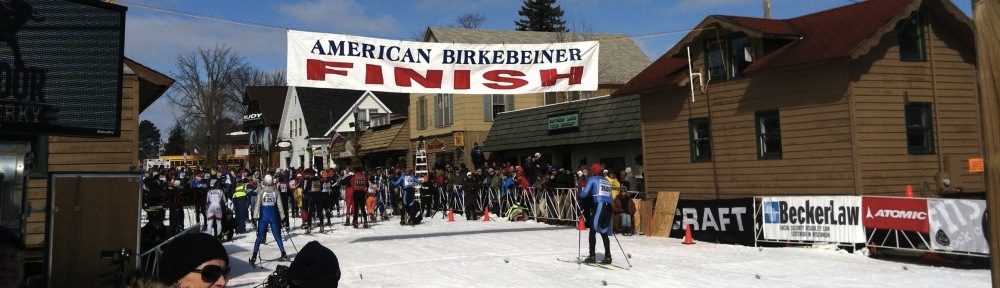
2017: the year of the Friday Korteloppet

It’s happened: the Birkie has outgrown two races on the same day. (Remember, as many people skied the Birkie alone in 2016 as skied the Birkie and Kortie combined in the mid-2000s.) So starting in 2017, the Korteloppet will be on Friday. There are certainly pluses and minuses to this and while I think the Korteloppet would do better on Sunday morning, I understand why that might be a no-go. But with Telemark closed, it certainly makes sense to shift the finish of the race towards Hayward for all the races, and the recent additions to the Birkie trail help as well.

Update: here’s the official announcement email from the Birkie. We’re talking to the Birkie about a longer podcast discussion about these changes; stay tuned!

In any case, here are some pros and cons for having the Korteloppet on Friday:

Pros:

  • Main Street finish. Now that the Birkie Bridge is in place, the race can use the Main Street finish for more activities than just a few hours on Saturday. This is pretty cool, since Main Street was otherwise underutilized on Friday.
  • One finish area will better utilize the resources the Birkie has.
  • Busing is a lot easier. On Saturday, there will be much less demand for busing since it will be Birkie skiers only. On Friday, most Korteloppet skiers will be able to park near Hayward, ride a bus to the start, and ski back to their cars. Currently, all Korteloppet skiers have to park remotely and ride a bus to and from the start/finish area. This will save everyone time, money and headache.
  • The Birkie Trail, where it is shared between classic and skate skiers, is wider than the Kortie trail. Unfortunately, the shared section starts much earlier than the current situation (2k, maybe, instead of 9k; see below).
  • The Birkie start will be much simpler for non-elites (it won’t change for elites) who will have smaller waves and won’t have some waves led out by skiers going at a different pace in a different race.
  • Some crazy skiers might try to ski both races. Those of us obsessed with our wave placement (that’s pretty much all of us, right?) probably won’t, but I’m sure some folks will. (This from a guy who’s flown to Minneapolis to ski the Loppet Challenge, twice.)
  • The Korteloppet will get significantly longer, from the current 24km to nearly 30. Of course, there won’t be any major climbs for the first 10km, although several after that point (Bitch Hill included).
  • Birkie skiers will have the opportunity to go and cheer Kortie skiers on Friday, and Kortie skiers will be able to return the favor on Saturday. (Or volunteer!)
  • During a year like this one, the Korteloppet trail would be a good option for skiing on the days before the race when the main trail is closed, although current maps show most of the Kortie Trail closed except for race day, so it may be subject to land issues.

Cons:

  • The start area for the Kortie will be … constrained. I’m guessing that the Kortie start may use the field to the southeast of the start area, which is about 150m long and 25m wide. This could, in theory, stage enough skiers for the start, but the trail gets pretty narrow pretty quickly, so I’m not sure how it would transition in to the race. The Birkie may have to widen the course and carve a new start area out of the woods at OO.
  • There is no longer a separate classic trail for the first 9k of the Korteloppet. Classic skiers may be separated for the first couple of kilometers on the OO trails, but will pretty quickly rejoin the skate race. If the classic trail is extended south from OO to or past Mosquito Brook, however, it would be a boon to both skate and classic skiers.
  • The Picnic Table hill may be a mess, with a steep, curving downhill 1k in to the race. Good luck with all that.
  • The Korteloppet gets a little easier, although with the removal of the Power Lines on the north end and the new hill on the south end, this might be a wash.
  • There’s no feed for the first 9 km of the Korteloppet between OO and Gravel Pit. For the beginning of a race, this is a relatively long stretch to not have a feed.
  • The Korteloppet will have four road crossings (Mosquito Brook, Highway 77, Wheeler, Duffy’s) where today it has none. This might be a chance for the Birkie to improve snow conditions at the road crossings, and in the long range look in to grade separation for the roads.
  • In the case of a low-ice year (which hasn’t happened in a while) the race would have to end on a field shy of town.
  • The purpose-built Korteloppet trail will have only lasted for about 15 years, although it will still serve as a recreational trail (and for races such as the North End Classic).

As a Birkie skier, I am mostly unaffected by these changes, but they will by-and-large be positive for Birkie skiers. The main issue is that many Korteloppet skiers may not be able to take the day off on Friday for the race. However, there are probably just as many who will come early to ski Friday and watch Saturday, people who are now spectators but may decide to ski as well. It will be an interesting experiment, hopefully the Birkie will pull it off.

Good thing the Birkie was last week

This year, the Birkie was held a week “early”, i.e. not the last full weekend in February.

It’s probably a good thing. Here are the temperatures in Hayward for today the 27th (clear and sunny the whole time):

7 a.m. 28˚ (and several hours under 28 overnight = frozen and fast)
8 a.m. 31˚
9 a.m. 34˚
10 a.m. 41˚
11 a.m. 46˚
12 a.m. 49˚
1 p.m. 51˚
2 p.m. 54˚
3 p.m. 53˚
4 p.m. 46˚

So, that would have been a pretty fast course for the elites, but even some of the south-facing hills (downhills, mostly, like the one at 34k and a couple after Mosquito Brook) would have probably been baking and slushy. But for later starters, anything out of the shade would have been corny. Which isn’t bad: it would have been fun, spring skiing. But no “better” than last week.

On the other hand, it would have been an excellent day for drinking beer on Lake Hayward.

A week already? Podcasts and more!

It’s hard to believe that it’s already been a week since the Birkie. Well, six days. With the leap year, it’s only 365 days until Birkie 2017. But who’s counting.

By now I usually have a race recap up. And I will! But I’ve mostly been working on two (2) more podcasts. And by working I mean sending sound files to the producer and saying make these sound happy! By the way, you are now legally bound to listen to his podcast, Outside/In, because I want him to love me and if he doesn’t, my podcast would sound terrible.

Okay, so podcasts. You can find podcasts here, or click the button up there that says “podcast” or use this iTunes link. If you are having trouble downloading them (maybe because people after the race used some bad language and we had to put an explicit tag on them) here are links to episodes 1, 2 and 3. Episode 2 was recorded at the pasta feed that I have attended for 9 years or so (and it’s been around longer than that!) and episode 3 is me talking to people on Main Street. This was a lot of fun, and no beer was involved in the making of the podcast either!

One other thing: The Birkie maybe could have been held tomorrow, since it’s still the last full weekend of the month (I’m not sure why it wasn’t; it might be because the Gatineau Loppet was pushed back because of the Canadian Ski Tour, or something). If it had been, it would have been interesting weather. It is going to freeze overnight tonight, but tomorrow should be sunny and top out in the mid-40s. That would have been about as interesting race weather as we had last week. But it would have made for great spectating.

DO NOT SKI ON THE BIRKIE TRAIL (after Wednesday)

The Birkie has issued a missive that you are not to ski on the Birkie Trail after Wednesday night.

This is really important.

The trail has good cover on it, but the weather on Thursday and Friday is iffy. It is going to be above freezing on Friday, and may not go much below freezing on Friday night. I would assume that they will groom the trail when it’s still cold on Thursday, let it set up and then leave it be. If they groom it on Friday when it has moisture in it, it might freeze in to ice, which is bad. If they leave it be, it will absorb the moisture and might freeze it in to it (the snow can store a lot of latent cold in the snowpack) and we’ll have decent conditions.

But if you ski the trail, you will put ruts in to the snow. And if those ruts freeze, we’re all in deep trouble.

There are other places to ski in the area, including the Birkie Ridge trail up to the Birkie Trail and back, check out Skinnyski’s reports here. These trails will not damage the race course. But don’t even think of skiing on the Birkie Trail on Thursday or Friday. Not even a thought. Mmkay?

10,000 skiers say thank you.

Weather Speculation: A Balmier Birkie?

1998 to 2007 was a dark period for the Birkie. The race in 2000 was canceled, 1998 and 2007 were shortened significantly, 2002 finished short of Main Street, and 1996 had race temperatures well in to the 40s; I can only imagine that it was a soggy, slushy Birkie. (Our weather history chart is here; I’ll update it soon with more recent data.)

Since then, we’ve had a run of good luck. Even in 2012, where there was hardly any snow south of Birkie, the course was perfect. The only downside has been the cold; some of the coldest Birkies have been held in the past decade. Still, eight races with pretty much perfect snow in a row is not too shabby, especially in a time of warming temperatures across the globe. If you’d told me after we skied 25k on rock skis and slush in 2007 that we’d have perfect snow for the next decade, it would have sounded like wishful thinking in a year where there wasn’t more than three inches of snow on the trail before race day.

This year shouldn’t lack for snow; there’s enough on the trail (although more would be nice) and we’re unlikely to face a 2000-esque meltdown (when 15 inches were washed away in a few days), but unlike most of the races in the past few years, it won’t be cold at the start. So you can leave your buffs, dermatone and maybe even wind briefs at home; it’s very unlikely that we’ll need a “-” in front of the temperature, at least not in Farenheit.

We might not even need it in Celcius. The two models are getting in to range, and both show a warm up at the end of next week. The European model shows temperatures peaking on Friday night just above freezing, with a mix of rain and snow falling on race morning. This would be interesting to say the least, and would cause a run on fluoros at the local ski shops. The American model brings the warm air in a bit earlier, with temperatures in the 30s on Friday, but falling back through the 20s on Friday night. With any moisture added to the snow, this would create a lightning-fast track for Saturday morning. The Canadian model, for what it’s worth, parallels the American model with a cold front swinging through on Friday afternoon.

Unless the models are wildly wrong, there should be no real threat to having enough snow for the race and a ninth straight Birkie with good snow. But it might be the first time in a while the start of the race we won’t have to layer and layer and layer up.

The BirkieGuide Podcast is (almost sort of pretty much) here

bgpimage2They said it could never be done. (Wait, that’s a lie.) But it has been done. All hail the BirkieGuide Podcast!

UPDATE: It’s here!

In the first episode we spend nearly half an hour talking with Ben Popp and Al Serrano about the 2016 race. Want to find out about the new hill at Rosie’s Field? It’s in there. The new finish procedure? Yup, in the podcast. Some recording magic from our friend Sam of the Outside/In Podcast, who made the whole thing sound better than a skype conversation? That too is in the podcast. Basically, you should download the podcast, and listen to it a bunch of times. Don’t download it a bunch of times or my server might crash, though.

How do you download it? Well, soon, it will have a link in iTunes and you can download it there. For now, you can download the .mp3 file directly or copy the following link and go in to iTunes and select “File–>Subscribe to Podcast …” and then paste this link (http://birkieguide.com/podcast/feed.xml) and it will subscribe you to the podcast. Do you get your podcast somewhere else? I am pretty new to this so you may have to help me out, and I can submit the feed elsewhere, too.

Want to be a guest on the BirkieGuide Podcast? Email me. Seriously. We can talk.


The New York Times is Stealing My Ideas

Well, not really. And as usual I used the title here to reference a Seinfeld quote. But the New York Times has a data piece out about the NYC Marathon this weekend showing a time lapse of people running along the course:

Does that remind you of anything?

Well, I guess if I was two years ahead of the Times, that’s okay by me.

The new start area

You may have seen that the Birkie is fundraising for a permanent start area. You may have gotten an email, or two, or three. The Foundation is pushing this start area, and we here at the Unofficial Guide think that it’s a good idea. So if you have some extra dollars floating around, maybe you don’t need another pair of Triacs this year, and can send a couple of bills over to the Birkie. (If you want to send a pair of Triacs to me, 175 cm, please, I’ll give you my address, and even pay shipping!)

Anyway, while a lot of us new-timers think of the Birkie as being a fixed route from Cable to Hayward, that has not always been so. Up until 1992, the race switched direction every year. In the ’80s, is started up Mount Telemark, before winding its way through the Telemark trails and on towards Hayward. The Foundation added a bit through Fish Hatchery this year (which probably needs to be widened), added the Classic Trail, and has rejiggered a few other sections as need be. The trails is a living, breathing organism, and change is not always for the worse.

The start isn’t going to change dramatically. It will be rebuilt near the current start, but off of the airfield, which the race needs an FAA waiver to use every year. The trail itself will bear the brunt of the change. It will lose about one kilometer of distance, so the Fish Hatchery joggle might be to keep it at 50k. And while the elevation will remain about the same, it will be much less steep. The first hill on the power lines—the one that separates the men from the boys—will be cut out, meaning there won’t be a gaggle of V1ers a kilometer in to the race, but a faster V2 start out of the gates. The main concern is that the course won’t be wide enough at the start, and hopefully the course designers keep it plenty wide. I would say the course should be at least 20m wide from the start to the power lines, especially since it’s climbing most of that way.

The major upside? A new start building. Tents are expensive, annoying, and can collapse when 18″ of snow falls on them. Having a building, however, would be supreme. Would it be able to handle 10,000 skiers on Birkie morning? Certainly not: you’d need an outright convention center for that (or at least the Hayward High School). But it would be an upgrade over a damp tent pitched on snow with a hay-covered floor. And, theoretically, it could serve other purposes throughout the year: a chalet during ski season and bike season, and an event center on weekends year round. What Birkie skier wouldn’t want to have their wedding at the Birkie start?

The Craftsbury Outdoor Center in Vermont is an interesting case study. It hosts the Craftsbury Marathon, a tiny ski race in New England (well, tiny by Birkie standards) but is similar to the Birkie in that it has low user fees, dependable snow and terrific grooming. It is basically funded by the Driessigacker family (of biathlon fame) and their family business: Concept2 rowing supplies. (They make the SkiErg, too. Why? Because they’re skiers.) Concept2 has done tremendous business in the past few years, especially since CrossFit has decided to use Concept2 in their “workouts.” (I speak only derisively of CrossFit, although now every time I run by a CrossFit gym and see people paying oodles of money throwing balls or whatever I smile and think of how they’re funding skiing.) Craftsbury has a huge new chalet and training center that the Birkie would be lucky to have, several large solar arrays, a fleet of groomers, and some of the lowest trail fees around. The Birkie doesn’t have such a benefactor, but it makes up for it with tens of thousands of skier-supporters Together, we can make that kind of difference.

With Telemark quite possibly past the point of no return, it’s time for the Birkie to decide its own future. Is it free? No, it’s not free. Can you gripe about how much the race costs? Sure, but I just paid $175 to run the Boston Marathon and wait to retrieve my gear bag from a tent in the pouring rain. And they didn’t have to groom the roads. If you want the Birkie to thrive, and you can step up to the plate, you should. This is just phase one, and a few dollars from each Birkie skier would go a long way towards assuring a top-notch experience for decades to come.

A great day for US skiing, brought to you by Birkie & Kortie champions

I posted this on Facebook earlier, but not everyone who reads this is my friend on Facebook, so here it is on the Internet:

This video is amazing:

If you have five minutes, watch it. If you have an hour, watch the whole race (start at the 1:00:00 mark) as the announcers realize that Caitlin is in position for a podium and are utterly shocked by it.

I’m not.

Caitlin is a friggin’ rock star who, through various happenstance, has been on the outside looking in way more often than she should be. She skied at NMU because back in the early 2000s, that’s what you did: ski in college. (I vaguely remember watching her start a race in Ironwood and smoking the field.) Then she was told she should have been on a development team, and was too old to be supported. She was selected for the Olympics in 2010—I interviewed her on a sketchy Skype connection for the Loppet newsletter a few weeks after—but only at the last minute after she had skied fast enough that they couldn’t rightfully leave her off (again she was “too old”), and then had to pay her own way to World Champs. In 2011 she won the Birkie (note to November Project types: the temperature—not windchill, temperature—was -11. Can you say #‎weatherproof‬?) and 2013. In 2014 she was left of the Olympic team because of, among other things, internal politics, and she was too old, (although her husband got to go to Sochi). I asked her last year if she was considering another run at the Olympics in 2018 or hanging up the—well, not the spikes, bindings? let’s say bindings—and she was only a little non-committal: 37 is old even for skiers, but especially for US Ski Team selection. Good thing she kept after it.

Caitlin and Brian—Team Gregg—are also super-active in the community, working with the Loppet Nordic Foundation and hundreds of at-risk youth in Minneapolis. Caitlin rollerski trains on residential streets in Saint Louis Park (yup, I went out with her once, and it was not easy to keep up). After a swooping hill where I was trying not to crash she says “it’s nice, these hills remind me of the World Cup courses.” A suburban street west of Minneapolis. She represents the best there is of citizen athletes.

This year, she skied her way on to the World Championship team—even still, there were lingering questions about whether they’d take her. And today, she showed that she belonged on the track. This is no disrespect to anyone else on the team: Jessie Diggins had an amazing race (we expect greater things!), and all four American women were in the top 15. (Charlotte Kalla smoked everyone, of course.) Did the snow matter? Sure. But the skier makes the skis fast. For those of us watching Jessie win high school races in Minnesota, it’s especially cool to watch her perform at such an elite level. But for Caitlin, it is years of vindication: she more than belongs.

Yes, Charlotte Kalla will be above the fold in every newspaper in Sweden (and deservedly so). But guess who’s flanking her in every picture? Not Marit. Not Therese. Jessie and Caitlin. The day belongs to the American Women. And I hope we’re not done seeing great things from any of them.

So, that happened

This morning, I went out for a crust ski on the Charles River.

IMG_5981

I’m not kidding. The river is well frozen, and the crust has seen enough sun and moisture that it’s pretty perfect. A couple frozen drifts here and there, and some ice under the bridges. It’s pretty great. I might call for a ski race on it some time this week.

Then I got to my office and turned on the Internet and Caitlin and Jessie had broken the Internet.


This is pretty awesome. Caitlin won the Birkie in 2011 and 2013, and Jessie the Korteloppet in 2008 and 2009. That’s four Birkie event wins! To have them both on the podium, and with significant payouts too ($10k and $6k), is really fantastic. A great day for US skiing.

This page interviewed Ms. Gregg last year, and maybe she and Jessie will join us again soon (maybe for a podcast; yeah, we might start doing podcasts).