Ari’s Unofficial Guide to Skiing in the Cold

So, we’ve I’ve decided that it is going to be a cold Birkie. Either windy and cold, or calm and really cold. The jury is out on what kind of cold, but it won’t be a 35˚ slushfest. Thank goodness.

I realized that there may be some out-of-towners who have never skied a cold race—or never really skied in very cold temperatures at all. I say this from experience: skiing in high school in Boston, I never needed more than a pair of thin gloves. My first college race was at Mount Itasca in Colerane, Minnesota, deep in the Iron Range. It was 3˚. The race was straight up a manmade snow hill, and straight down it. The downhill was frigid. At the end of the race, unable to move my fingers for an hour, I promised my coach that the next day he’d take me to get lobster mitts. I’m on my fourth or fifth pair, and will have them on Saturday.

So there are skiers like me, who might be from New England, or the Mid Atlantic, or California, where temperatures below 0 are sporadic enough that they don’t have experience in them. (On the other hand, in the Upper Midwest, people are tired of it; this winter it has been below zero 42 days in Minneapolis, 59 days in Hayward and Duluth—including a record-setting 23 days straight—and 67 days in International Falls.) As someone who learned the hard way and have since raced a number of races in adverse, cold conditions, here are some tips to staying comfortable in the cold:

  • Don’t overdress. One mistake I’ve made time and again for my first cold (<-5) ski of the year is to freak out about the temperature, wear what I should be wearing, and then throw a down parka over that. It won’t be -20. Dress in thin layers, and don’t wear too much. For 0, I figure three pairs of long johns or race pants on the bottom, and three wool/polypro layers on the top.
  • For god’s sake, don’t wear cotton. This should go without saying. Wool is your friend. Polypropylene is also your friend, but will get stinky.
  • Keep your hands warm. You’d rather have warm hands than cold hands, so grab lobster gloves if you have them. If not, swing by a ski shop and pick some up, you’ll be glad you made the investment. If your lobster mitts are getting old, a pair of liner gloves might be the trick to not having chilly fingers.
  • Keep your head cool. You will get warm as you race. If you have a thick hat on, you’ll get very hot indeed. A thinner hat is probably fine, with perhaps a buff or a headband to keep your ears warmer. And don’t ski with your favorite hat, if you get very hot and throw it during the race you’ll probably never see it again.
  • Get a buff. It’s great because you can use it to cover different parts of your face during the race, and it’s very adjustable. I usually start with mine over my ears, cheek and neck, and then can pull it down if necessary just to cover my chin and neck.
  • Don’t go overboard covering your face. You need to be able to breathe, and nothing is worse than an ice-caked piece of cloth slamming in to your chin with every breath. The ambient exhaled air should keep your face somewhat warmer than the air around it. If you are prone to frostbite, take necessary precautions, but breathing should come first. If you keep the area around your face warm, your face will be fine.
  • Wear sunglasses or other eye protection. Even if it’s not sunny. It will be bright, and your eyes will get icy if you don’t. If they get foggy you can always perch them on your forehead, but you’ll be glad to have them in case.
  • You should be cold at the start line. When you’re standing around waiting to start, if you’re warm and comfortable, you’ll overheat and get wet during the race. This is not a good thing. If you’re chilly, you’re probably dressed right. If your hands get old, spin your arm around, the centrifugal force gets blood to your fingers. It feels odd, but it works.
  • DRY YOUR BOOTS. Nothing, and I mean nothing, is worse than putting on wet boots on race day and skiing in the cold. You’ll have cold feet, which lead to poor balance, which leads to tired legs. If your boots are moist from a ski the day before, put them on a heat vent or radiator or put a fan on them, or even put on dry socks and walk around in them—anything to get the insides dry.
  • Gents, two tricks. One, don’t shave. Facial hair is good insulation. Two, if you have an extra hat and you’re worried about certain areas “down there” just stuff it in between a couple of layers. It looks weird, but it certainly does the trick.
  • The more adjustments you can make during the race, the better. The temperature will change, and you want to be able to change with it. I do this in several ways. The aforementioned buff maneuver. I’ll sometimes perch my hat above my ears (if it gets really hot, I’ll take my hat and stuff it in my pants somewhere), it’s amazing how much heat you can dump with bare ears. I often wear a hooded wool layer, and the hood can go up or down (usually starts up and comes down) if I’m hot or cold. And zippered top layers can help you cool down if you’re overheated.
  • Your drink belt will freeze. You can heat it up, turn it upside down, put a heat pad in there, whatever. Your camelbak hose will certainly freeze. If it’s below 0, you’ll be out of luck. Above 0 you can usually keep it liquid with a few shots of Whiskey, but below 0, you’ll be drunk if it is potent enough to remain liquid.
  • You will need warm, dry clothes at the finish. Often my legs are fine, but my core is always wet from sweat. The first thing you want to do in the changing tent—before you even get that first beer!—is stip off any wet layers and put on dry ones. Which means you want those in your drop bag. And you’ll want to be warm and comfortable. I usually go with a wool base layer, a cotton sweat shirt and a down jacket on top, plus dry gloves (dry liners inside your wet lobsters can work), a dry, warm hat, DRY SOCKS and shoes. And dry pants are never a bad idea, if they get wet during the race.
Follow these fifteen or so steps and you’ll survive. I hope.

Where to ski on Friday

In the past two years the Birkie has had the trails open in stages until Friday afternoon for last-minute skiing. This year, not so much. The whole trail is closing on Thursday evening, in time for packing the last bit (foot?) of snow down. So if you want to ski a few k on Friday, your options in the Cable-Hayward Metropolis are somewhat limited, with nearly 100k of prime trail closed to use. Add to this the potential for a foot of fresh snow, and all grooming resources will be aimed at packing the Birkie Trail, so expect anything around the Hayward/Cable area to be soft, if it’s groomed at all.

If you are coming from the Twin Cities, I’d suggest skiing there. The Cities will be further west of the storm and see less snow—probably more on the order of 3-6 inches. The trails there are more likely to be groomed, and even if they’re not many crusted up today (it was in the 40s) and are refreezing, so the skate deck would be firm with snow on top. If you drive to Hayward early, you’ll not only see more snow on the roads, but you’ll be taking your chances at finding trails to ski on. Skinnyski is a great resource for finding trails and conditions, and we reviewed several local trails in the Twin Cities on this page. If you’re looking for a quick hit from the airport, Battle Creek is quite convenient, Wirth and Hyland are not far out of the way, and if you don’t mind a short extra drive, Murphy Hanrahan has hills which will remind you of the Birkie. Most likely to be groomed are Hyland, Battle Creek and Wirth. And Elk River, but that’s up the road the wrong way a bit.

Here are some options near the race, with links to Skinnyski’s trails pages (I’m only going to describe skate and classic trails nearby, but there are many more trails on the website):

  • With Telemark closed, the trails there have been groomed more sporadically than usual. It’s possible there will be good skiing on those wonderful trails, but they’ll probably be covered in fresh snow.
  • The North End Trails are great, but many double as portions of the race course. Still, you could probably find some skiing on them, and they might get a groom.
  • The Birkie Ridge Trail is another good option. It’s about 5k and right on Highway 63. It intersects the Birkie Trail so you’d have to ski out-and-back, but 10k should be more than enough skiing for Friday.
  • Likewise the Seeley Ski Trails are a good option that intersects the Birkie Trail. But they may not be groomed.
  • The Birkie has some skiable trails at OO, Mosquito Brook and Fish Hatchery. In each case, there are a few k you can ski on without disturbing the main trail. But none really more than a pretty quick out-and-back.
  • Just out of town in Hayward are the local recreational trails. A few k, probably enough to warm up on.
  • Balsam Branch and Timberland Hills are good options on the way up 63.

Tuesday Weather Speculation

You know what, guys? It’s going to be a damn good Birkie.

The NWS has hoisted a winter storm watch, so we’re looking at six or more inches of snow. It will start off moist (base) and then get dry and powdery as it gets cold and the storm pulls off. Friday will be chilly and windy, and Saturday morning looks cold and dry. The race will probably start either side of 0. Wind briefs and buffs will be the order of the day.

It was 38 in Hayward today, and should be 38 tomorrow. A dry, sunny 38 which will just serve to put a few ice crystals in to the base. However, if there’s enough snow these might not even get tilled up, so the race should be powdery. Soft-medium flex skis will be in order with a fine grind. Fluoros if you must, but cold powder is Start Green.

Q&A with Caitlin Gregg

She looks nice, but she'll kick your butt on the ski trail.

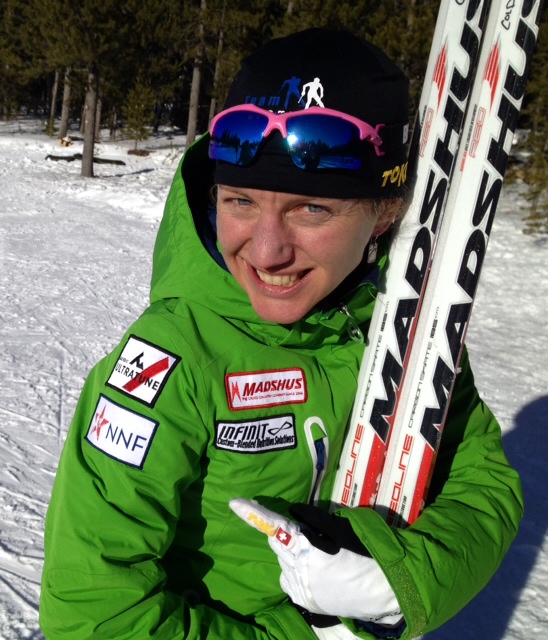
You know what’s awesome about nordic skiing? If you email someone who’s really good, they’ll email you back. Such is the case with two-time Birkie champ and 2010 Olympian Caitlin Gregg, who was kind enough to answer some questions about the Birkie, the Olympics and life in general with us. See what she’s been up to and where she’s going—other than really quickly from Cable to Hayward on Saturday.

The whole of the interview is here. Cheer for her in Hayward, if you happen to be the first person in.

Falling at the finish

There’s been a lot of talk these Olympics about why cross country skiers fall down a the end of the race. (See here and here, for instance.) I’m not good enough to go hard enough to fall down like that (I will slump over my poles, but usually not collapse; I need to work on going harder) but I will expound upon why Nordic skiers do this and no one else does.

There are two elements that go towards pushing yourself so hard that at the end of a race you can’t stand up anymore. One: it has to be a long enough race. A 400 meter dash demands an extraordinary anaerobic effort, but isn’t long enough to completely drain your body. A 50k ski race? Well, yes. And two, and perhaps more importantly: you need a sport which uses your entire body. While runners do fall down from time to time at the ends of races, they have muscle groups which are relatively underused during the event: the legs put out more power than the arms during a marathon. In skiing, you are demanding peak exertion from every muscle group, draining everything down until you have nothing left anywhere.

And there aren’t many sports like this. Bicycling uses mostly legs. So does running. Of mainstream sports, it seems that only rowing and swimming are similarly full-body. Longer swimming races are long enough to qualify, and a 2000m rowing race is six to eight minutes (depending on the boat). Long, but not two hours. But then, at the end of a swimming race, you’re in bouyant water clinging to the edge of a pool; most of your weight is supported by the water. Grab the edge and you’re set. If you’re rowing, you’re sitting in a boat. If you’re on skis, you’re standing on narrow, slide-y strips of wood that have no business being balanced, at the same time trying to catch your breath. Oh, you may have just thrown yourself off balance to extend a foot across the line. And you may have been doing it for an hour or two, full blast.

So, yeah, while it might sometimes be a little overdramatic, you may fall down. Find me another sport like that, and I’ll race it 50k. Otherwise, see you in Cable.

Notes on hyperbole

You may be enjoying our annual weather speculation. Do note, we freak out about everything. Including a few days of 38˚ weather. (Okay, not really; we just don’t want it to be 38 on race day. And it won’t be.) There’s a foot of snow compacted on the trail. Not a foot in the woods (there’s two feet of snow pack in the woods), a foot on the groomed, packed and tilled trail. Back in the day I ran some data of previous meltdowns in the Twin Cities when we were looking down the pike a some warm weather and the conclusion was that in January it’s damn near impossible to melt a foot of snow. A little easier in February (higher sun angle) but it ain’t happening unless it’s 50 for the next few days. And rains.

Skinnyski is saying don’t panic. If there were marginal conditions, we’d be hanging on every degree. As the second linked article mentions, the only difference 38 vs 41 will make is how much transformed snow forms up top to till in to the base. It will just make it faster. Weather speculation is full of hyperbole because it’s just that, speculation. It’s almost more fun when there is some question about conditions in marginal years, although I’d much rather have this kind of weather every time. A month ago, I posted that we’d be fine. It’s been above freezing exactly zero times since then. So, yeah. Birkie. It’s happening, guys.

Monday weather speculation

It might be really effin’ cold for the Birkie.

Just going to put that out there.

But first, Thursday. If you’re flying in on Thursday night, be forewarned that there may be some snow in MSP. Probably not enough to cancel flights, but maybe enough to allow you to move your flights around if things get tricky. Up in Hayward, you’ll probably see 2-4 inches of new snow, starting a little wetter and then, as the temperature drops, getting dry and powdery. This will be on top of a base which will see sun and temperatures in the 30s for the next two days, so the surface will transform in places (but perhaps not on north-facing uphills, which are most hills in the race). With new snow and lots of grooming, I would expect a course much like in 2011: mostly cold snow with a little ice mixed in to keep it fast, but not enough to require klister or anything.

On to the temperatures. They’ve been trending downwards. While at first it looked like the warmer air might hang on in to Birkie day, it now looks like it will depart on Thursday night. As high pressure settles in, winds will slacken. If they go calm on Friday night, with new snow, the temperature will drop, and we could make a run at the all-time record (-14) or the 2011 mark (-11). Luckily, we only get that cold if there’s no wind, so wind chills won’t be worse. And given the high sun angle, it should warm nicely, albeit only in to the teens, not the 30s. If it were early January, we wouldn’t be seeing zero.

Now things can change, and it could be warmer for the race. But the trends I’m seeing suggest colder. The NWS has been dropping their forecast temperature gradually, but they often build a regression to the mean in to long range forecasts. If the trends hold, make sure you don’t forget your wind briefs.

Weather speculation: Start waxing your softer skis

So after threat upon threat of a thaw seemed like a major possibility, recent guidance has pushed the freezing line southwards. It now appears that any warm temperatures in Birkieland will be minimally above freezing, quite possibly not enough to transform much snow. In addition, while the storm later in the week has been drifting off the models, a storm closer in—on Monday—should drop several inches of fresh snow on the course.

In other words: there will be a lot of snow on the course!

What we’re looking at are highs in the low 30s during the week—Tuesday, Wednesday and Thursday. There’s then a chance of snow on Friday, and with it cooler temperatures, with highs in the 20s. This should allow the course to set up nicely, but likely with some new snow groomed in, so it won’t be an icy, frozen base. An early call for Saturday would be temperatures around 10, perhaps a slightly breeze from the northwest, and some lingering snow.

But this can, and will change. So wax up those softer skis. Or leave them for the pros (shameless promotion of advertisers, look to the left). Also note that if you need last-minute lodging, check this out.

169 hours weather speculation

We are one week and one hour (and four minutes as I type) from the start of the Elite Mens freestyle race. One. Week. Away.

Here’s what’s going on with weather speculation.

The GFS has backed off of any real warm-up, and looks cold and dry for the race, with a few inches of snow midweek. It had been showing a “Panhandle Hook” type of storm before the Birkie, this is now delayed until Saturday evening and only a few inches of snow.

The ECMWF has the hook coming through on Thursday, and then colder weather for the race.

If I had to guess right now, I’d guess some fresh snow with some refreeze mixed in, temperatures at the start around 10. So it will probably be 30 and blizzarding; we’ll see.

(Anyone else catch MPR news drop the B-word yesterday?)

Weather Speculation: One week to go!

In a week, I’ll be in Hayward.

Let me take some ibuprofen; my fever has gotten high. And repeat:

IN A WEEK, I’LL BE IN HAYWARD. Say it with me. Again and again. There is no cure for the fever.

On to weather speculation. In the past day or so, the models have backed off of the very warm temperatures—to a degree. It looks like we won’t see temperatures breaching the 40 degree mark, and with cool nights the snow, if it transforms, will do so minimally. Then, there’s new snow. A few inches on Monday are likely. Then warmer Tuesday through Thursday.

After that is a wild card. The models have been flip-flopping, but a relatively constant theme is some snow. Some (the 00Z run of the Euro, for instance) have shown warm, wet snow the day before the race. Others (the 12Z GFS) show a cold front swinging through and more southeast weather system, which would bring several inches of cold powder during the race. But it could be a particularly white Birkie this year.

And it should be a nice ride for the next few weeks. Stay tuned!